
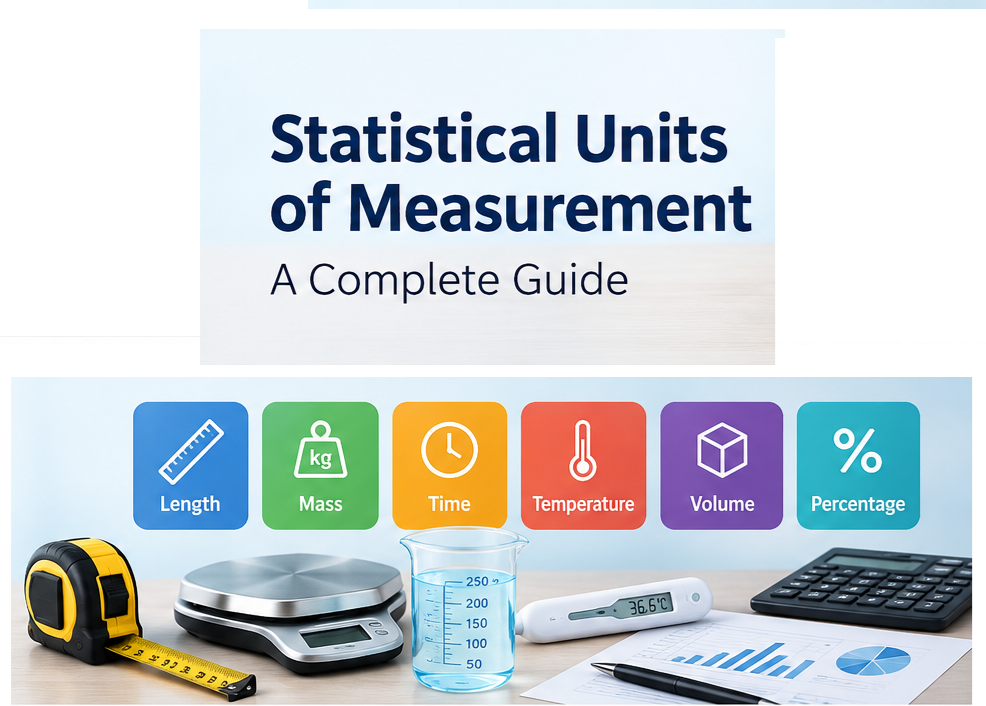
Statistical units of measurement are standardized ways of expressing numerical data. They allow researchers, analysts, businesses, and organizations to describe quantities consistently and compare information across different datasets.
For example, height can be measured in centimeters or meters, weight in kilograms or pounds, and temperature in degrees Celsius or Fahrenheit. Choosing an appropriate unit makes statistical information easier to understand and compare.
Units are especially important in statistics because numerical values have little meaning without context. A value of 50 could represent 50 kilograms, 50 meters, 50 percent, or 50 people depending on the variable being measured.
Why Are Units Important in Statistics?
Using consistent units is essential for accurate statistical analysis. When the same variable is expressed using different units, direct comparisons can become misleading.
Consider two measurements:
- 2 meters
- 150 centimeters
Although the numerical values are different, they represent the same type of measurement. Converting them to a common unit makes comparison straightforward.
Consistent units are also important when calculating averages, differences, rates, and other statistical measures. Incorrect unit conversions can produce inaccurate results even when the mathematical calculation itself is correct.
Common Units Used in Statistics
Statistical datasets can contain many different types of units. Some of the most common include:
Length
Length can be measured using units such as:
- Millimeters (mm)
- Centimeters (cm)
- Meters (m)
- Kilometers (km)
- Inches (in)
- Feet (ft)
- Miles (mi)
Mass and Weight
Common units include:
- Milligrams (mg)
- Grams (g)
- Kilograms (kg)
- Ounces (oz)
- Pounds (lb)
- Tons
Time
Time can be expressed in:
- Seconds
- Minutes
- Hours
- Days
- Weeks
- Months
- Years
Temperature
Temperature is commonly measured in:
- Celsius (°C)
- Fahrenheit (°F)
- Kelvin (K)
Area
Area measurements include:
- Square meters (m²)
- Square kilometers (km²)
- Square feet (ft²)
- Acres
- Hectares
Volume
Common volume units include:
- Milliliters (mL)
- Liters (L)
- Cubic meters (m³)
- Gallons
- Cubic feet
Units and Statistical Variables
The appropriate unit depends on the statistical variable being analyzed. For example, a dataset about the population of cities may use people as its unit, while a dataset about household income may use a currency such as dollars.
Some statistical variables are measured quantities, while others are counts or proportions.
For example:
| Variable | Example Unit |
|---|---|
| Height | Centimeters |
| Weight | Kilograms |
| Age | Years |
| Population | People |
| Income | Dollars |
| Unemployment rate | Percent |
| Distance | Kilometers |
| Time | Seconds |
Understanding the unit associated with each variable is an important part of interpreting a dataset correctly.
Absolute Units and Relative Units
Statistical information can also be expressed using absolute or relative units.
An absolute measurement describes a quantity directly. For example, a city may have a population of 500,000 people.
A relative measurement expresses a quantity in relation to another quantity. Percentages, rates, ratios, and proportions are common examples.
For instance, saying that 25% of a population has a particular characteristic provides relative information rather than a simple count.
Converting Units
Unit conversion is often necessary when combining or comparing datasets.
For example, if one dataset records distances in kilometers and another records distances in miles, the measurements should be converted to the same unit before comparison.
A basic conversion can be expressed mathematically. For example:
1 kilometer = 1,000 meters
Therefore:
5 kilometers = 5 × 1,000 = 5,000 meters
Using standardized units reduces confusion and improves the reliability of statistical analysis.
How to Choose the Right Unit
When selecting a unit for a statistical dataset, consider the size and nature of the measurements.
Small physical quantities may be easier to express in millimeters or grams, while larger quantities may be more conveniently expressed in meters or kilograms.
The chosen unit should also make the data easy to read. Reporting a country’s distance in millimeters would technically be possible but unnecessarily difficult to interpret.
Conclusion
Units of measurement provide the context needed to understand numerical data. They make statistical values comparable, support accurate calculations, and help readers interpret datasets correctly.
Whether you are working with length, weight, time, temperature, population, percentages, or financial data, selecting and consistently applying appropriate units is an essential part of good statistical practice.