SI units are the units that form the basis of the International System of Units, the internationally recognized system used to express measurements in science, technology, and many other fields.
The International System of Units provides a consistent framework for measuring physical quantities. Using standardized units is particularly useful in statistics because it allows measurements from different sources to be compared more easily.
For example, a scientific dataset can use meters for length and kilograms for mass regardless of where the data was collected.
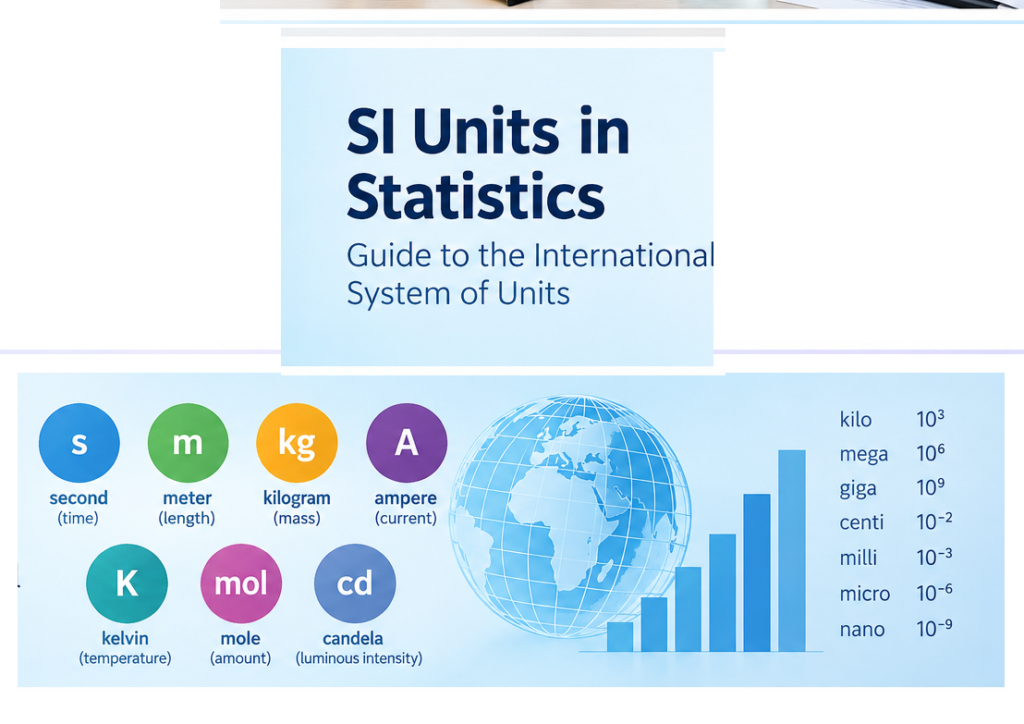
The Seven SI Base Units
The SI system is based on seven base units. Each one corresponds to a fundamental physical quantity.
| Physical Quantity | SI Base Unit | Symbol |
|---|---|---|
| Time | Second | s |
| Length | Meter | m |
| Mass | Kilogram | kg |
| Electric current | Ampere | A |
| Thermodynamic temperature | Kelvin | K |
| Amount of substance | Mole | mol |
| Luminous intensity | Candela | cd |
These base units can be combined to create derived units for other quantities.
Common SI Units Used in Statistical Data
Not every statistical dataset uses SI units, but they are particularly common in scientific, engineering, environmental, medical, and technical data.
For example, researchers may collect:
- Temperature in kelvin
- Distance in meters
- Mass in kilograms
- Time in seconds
- Area in square meters
- Volume in cubic meters
Using standardized units allows measurements collected by different researchers or organizations to be compared without ambiguity.
SI Prefixes
SI prefixes make it possible to express very large or very small quantities conveniently.
Some common prefixes include:
| Prefix | Symbol | Factor |
|---|---|---|
| Kilo | k | 1,000 |
| Mega | M | 1,000,000 |
| Giga | G | 1,000,000,000 |
| Centi | c | 0.01 |
| Milli | m | 0.001 |
| Micro | μ | 0.000001 |
| Nano | n | 0.000000001 |
For example, 1 kilometer is equal to 1,000 meters, while 1 millimeter is equal to 0.001 meters.
Why SI Units Matter for Statistical Analysis
Standardized units improve data consistency. Suppose a dataset contains measurements collected from several laboratories. If one laboratory records length in meters and another uses centimeters, the values cannot be compared directly without conversion.
Converting the measurements into a common unit eliminates this problem.
Standardization is particularly important when calculating statistical measures such as:
- Mean
- Median
- Standard deviation
- Variance
- Minimum and maximum values
- Rates and ratios
The unit of measurement is part of the meaning of the statistical result.
Units in Scientific Data
Scientific datasets frequently contain measurements involving several SI units.
For example, an environmental study might record:
- Air temperature in kelvin
- Wind speed in meters per second
- Rainfall in millimeters
- Area in square kilometers
Each variable has a specific unit, and understanding those units is necessary before analyzing the data.
SI Units and Data Visualization
Units should also be included when presenting statistical information in charts and graphs.
For example, instead of labeling an axis simply as «Temperature,» a graph should specify the unit, such as «Temperature (°C).»
This makes the visualization clearer and prevents readers from misinterpreting the numerical values.
SI Units vs. Other Measurement Systems
The SI system is not the only measurement system used around the world. Other units, including miles, feet, pounds, and Fahrenheit, remain widely used in some countries and applications.
When datasets use different systems, conversion may be necessary.
For statistical analysis, the important principle is consistency: measurements should be expressed in compatible units before they are compared or combined.
Conclusion
SI units provide a standardized language for expressing measurements. In statistics, this standardization helps researchers organize, compare, analyze, and communicate numerical data more accurately.
Understanding SI units is therefore useful not only for scientists and engineers but also for anyone working with quantitative datasets.